Launch offer — valid today only

📄 Digital book in PDF · read it on your phone or print it

The NABCEP PV Exam in Drawings: Every NEC Calculation in the Same Fixed Steps One Topic on Every Page

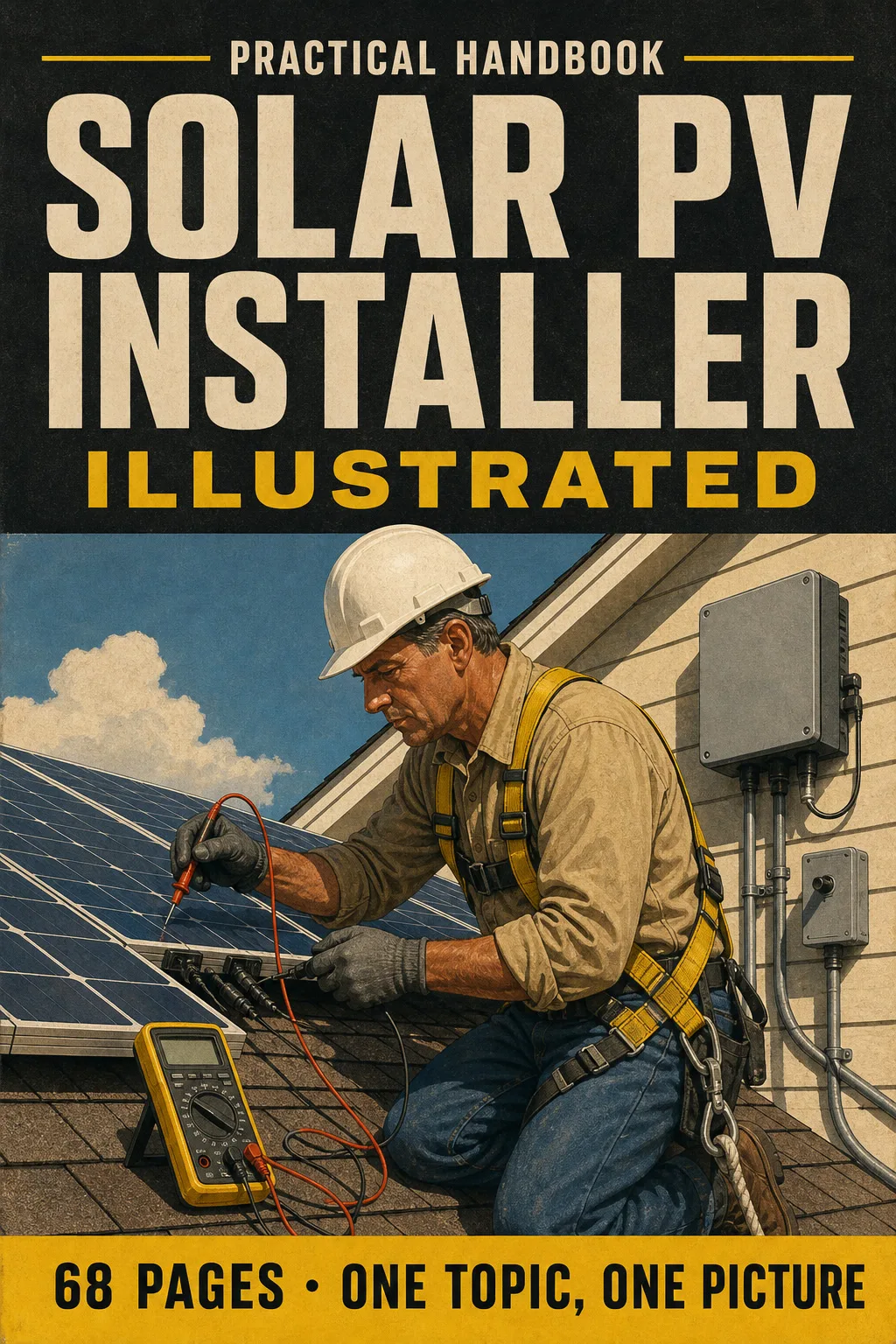
Cold Voc, string limits, the 125% and 120% rules, rapid shutdown, grounding, interconnection, storage and commissioning. Every topic gets its own page: the drawing first, then what you need to remember. 68 illustrated pages.

START STUDYING THIS WAY

🔒 Secure checkout · PDF by email · 30-day guarantee

Every topic, its own pageEvery NEC rule and calculation drawn, with the explanation right next to it
68 illustrated pages9 parts, from the cell-to-meter path to the final exam recap
Up-to-date sourcesNEC 2023 (Articles 690, 705, 706) and the NABCEP PVIP Job Task Analysis
PDF by emailFormat

Look Inside the Book

Every page has one big drawing and a box with the numbers, NEC sections and steps you need to know:

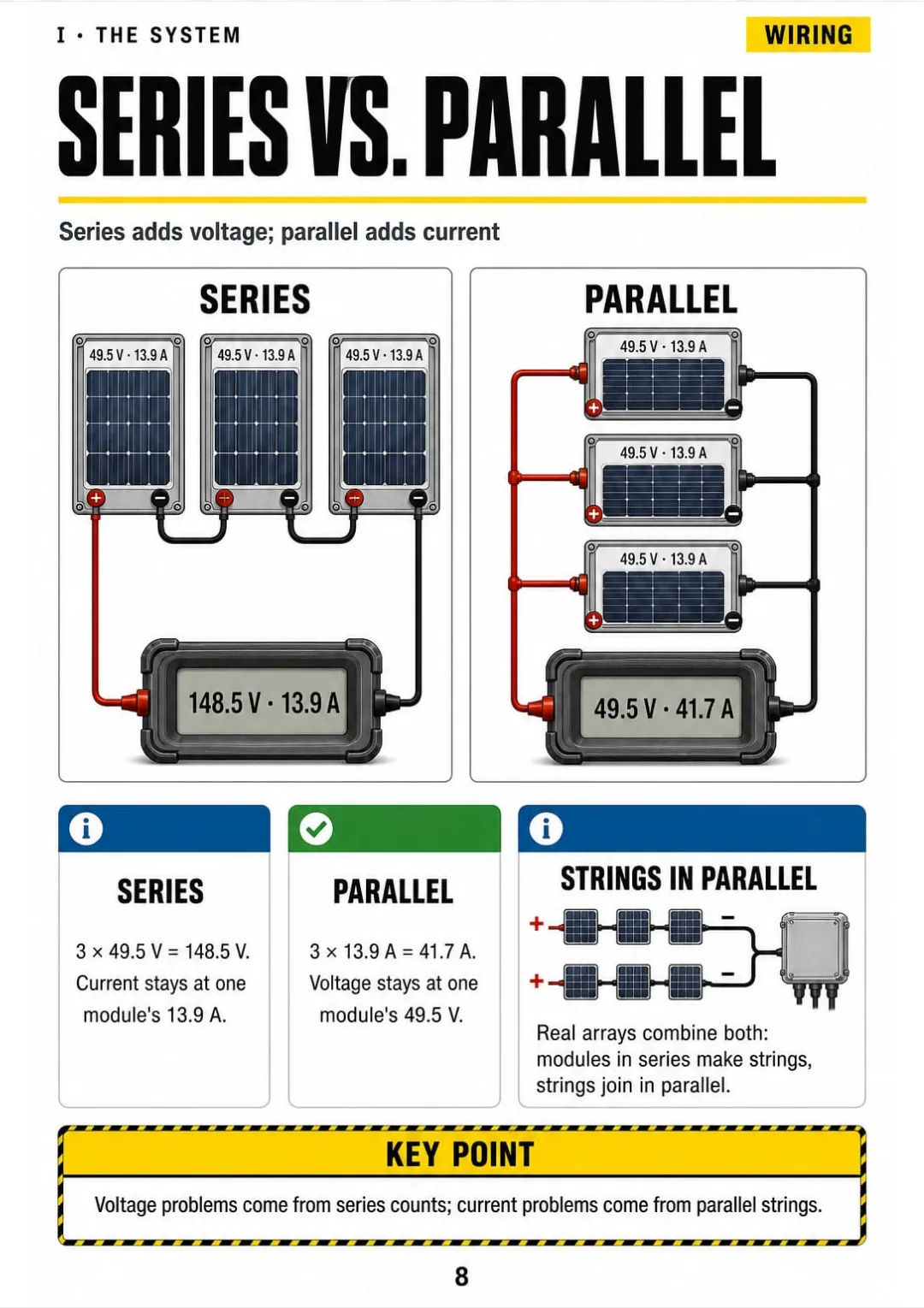
3 modules in series: 148.5 V, 13.9 A · in parallel: 49.5 V, 41.7 A
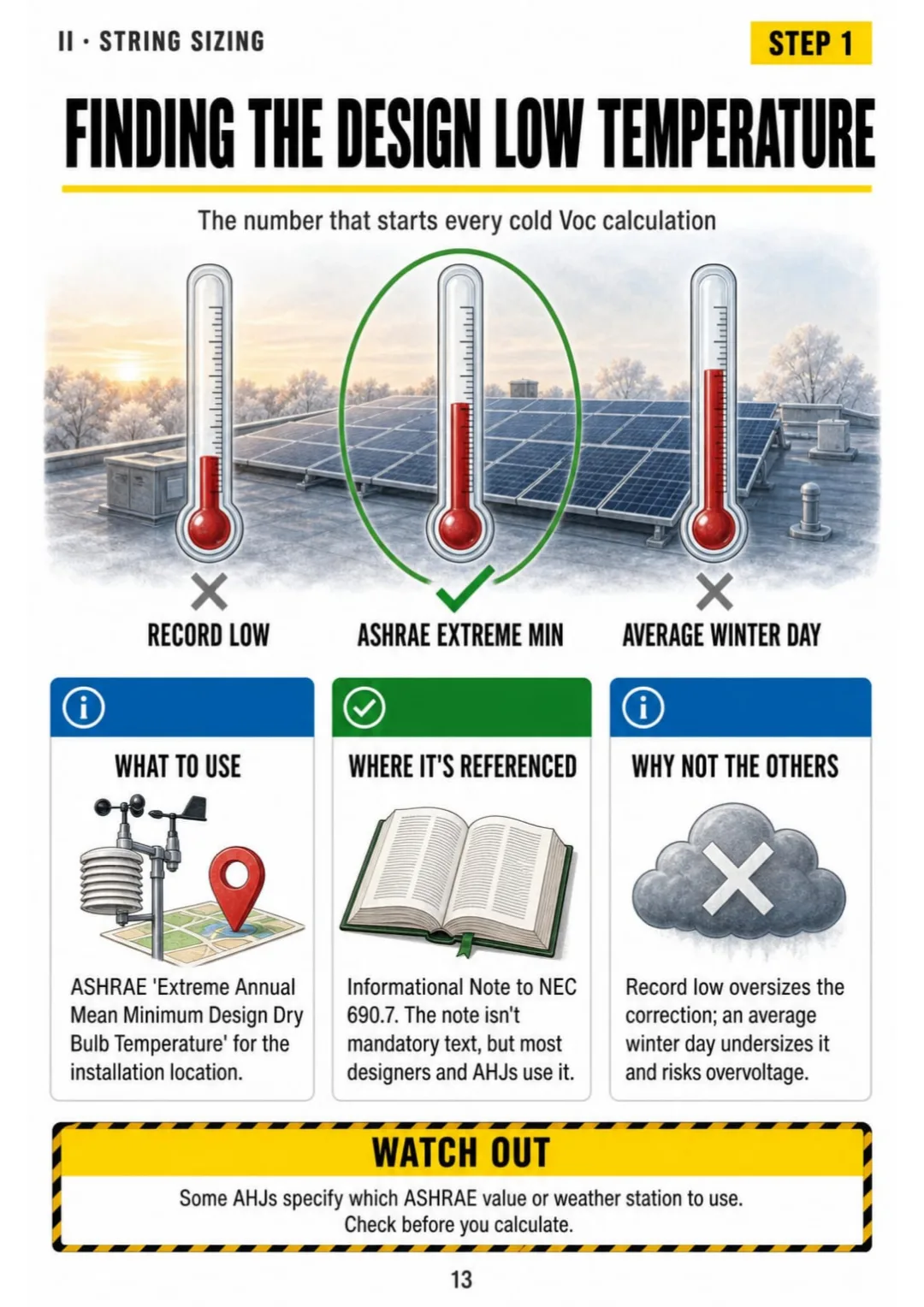
Design low temp = ASHRAE extreme annual mean minimum (690.7 Informational Note)
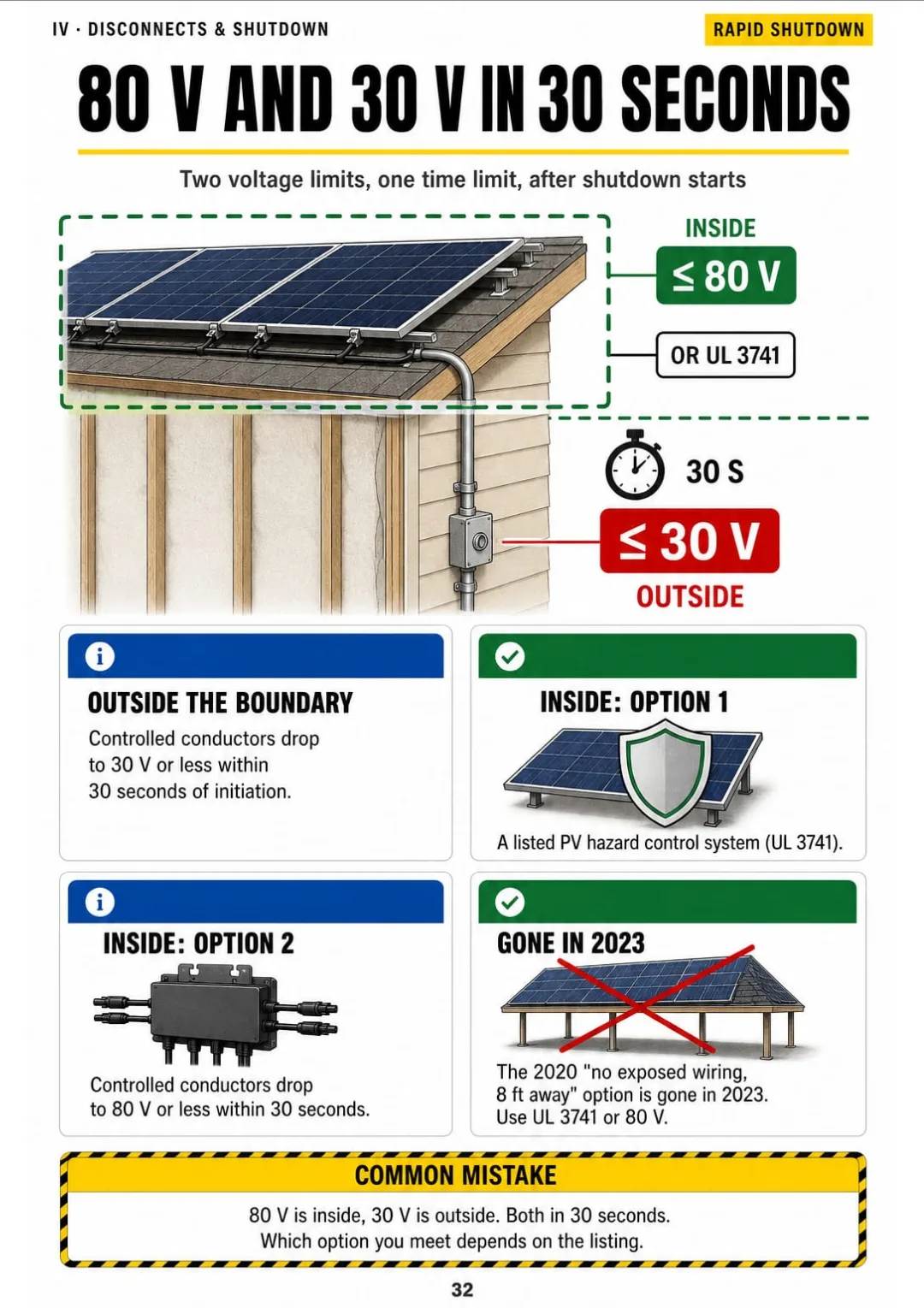
690.12(B): ≤ 30 V outside, ≤ 80 V or UL 3741 inside, within 30 seconds
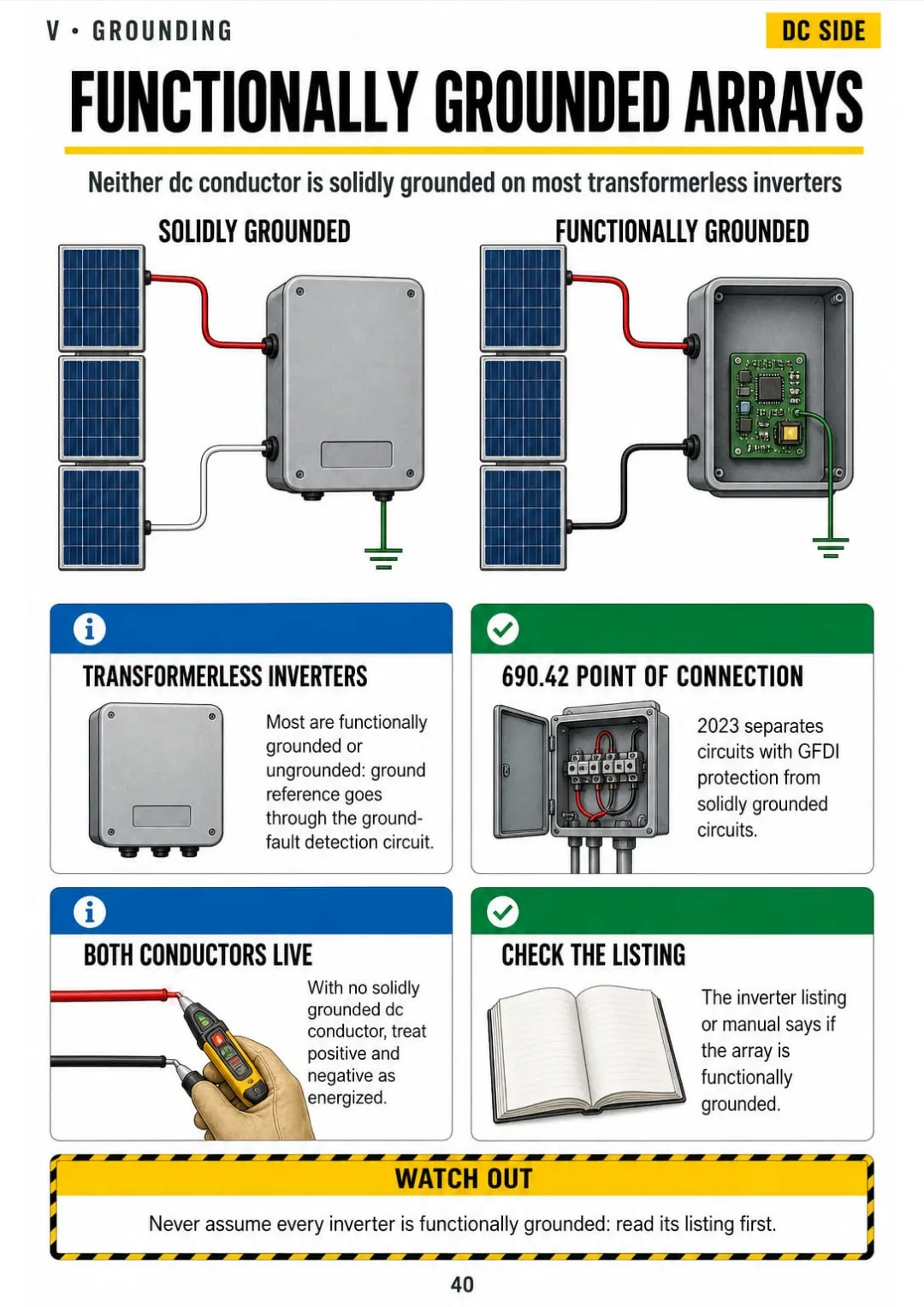
690.41(A) and 690.42: ground reference through the inverter's GFDI
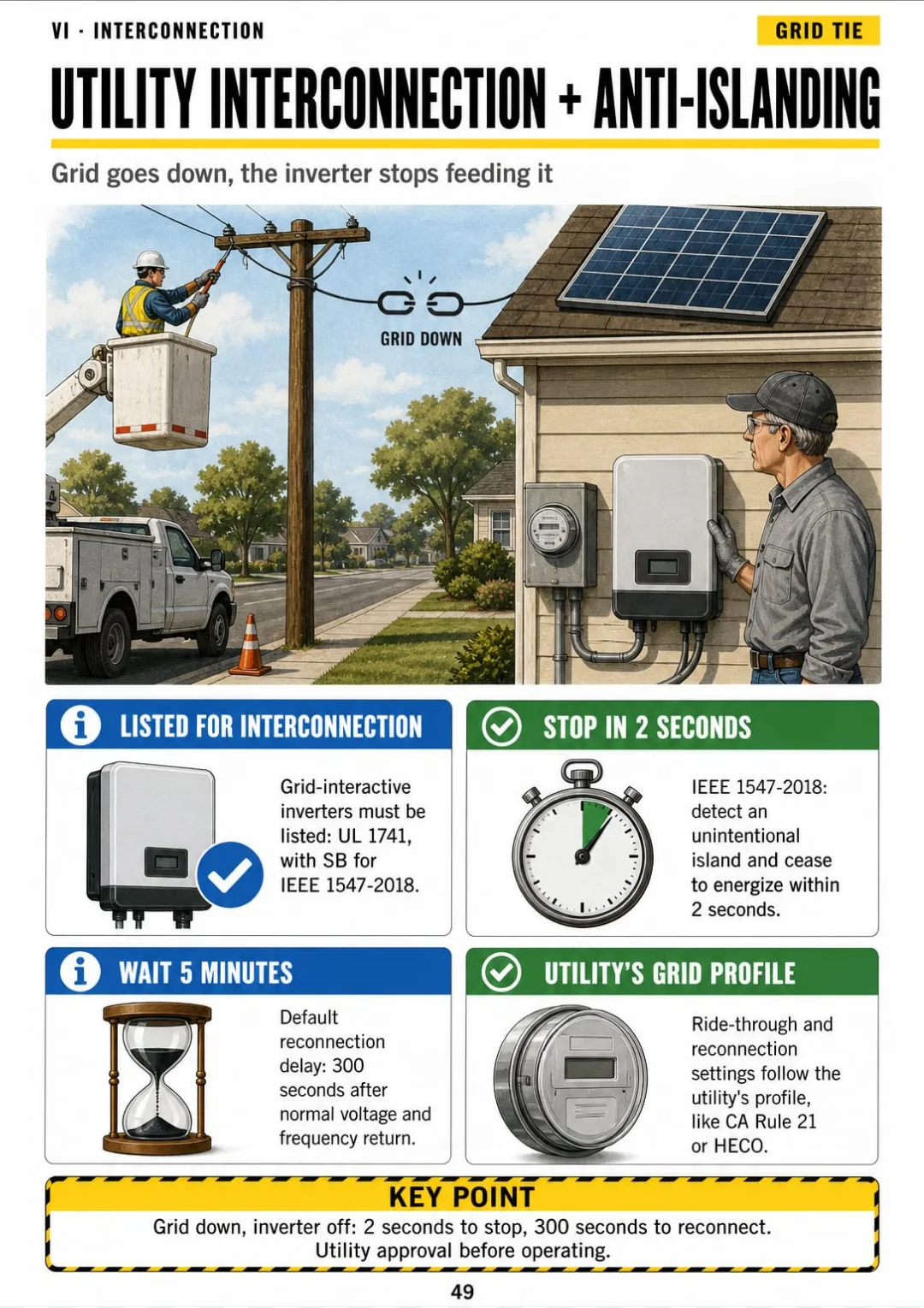
UL 1741 SB / IEEE 1547-2018: stop within 2 s on island, reconnect after 300 s by default
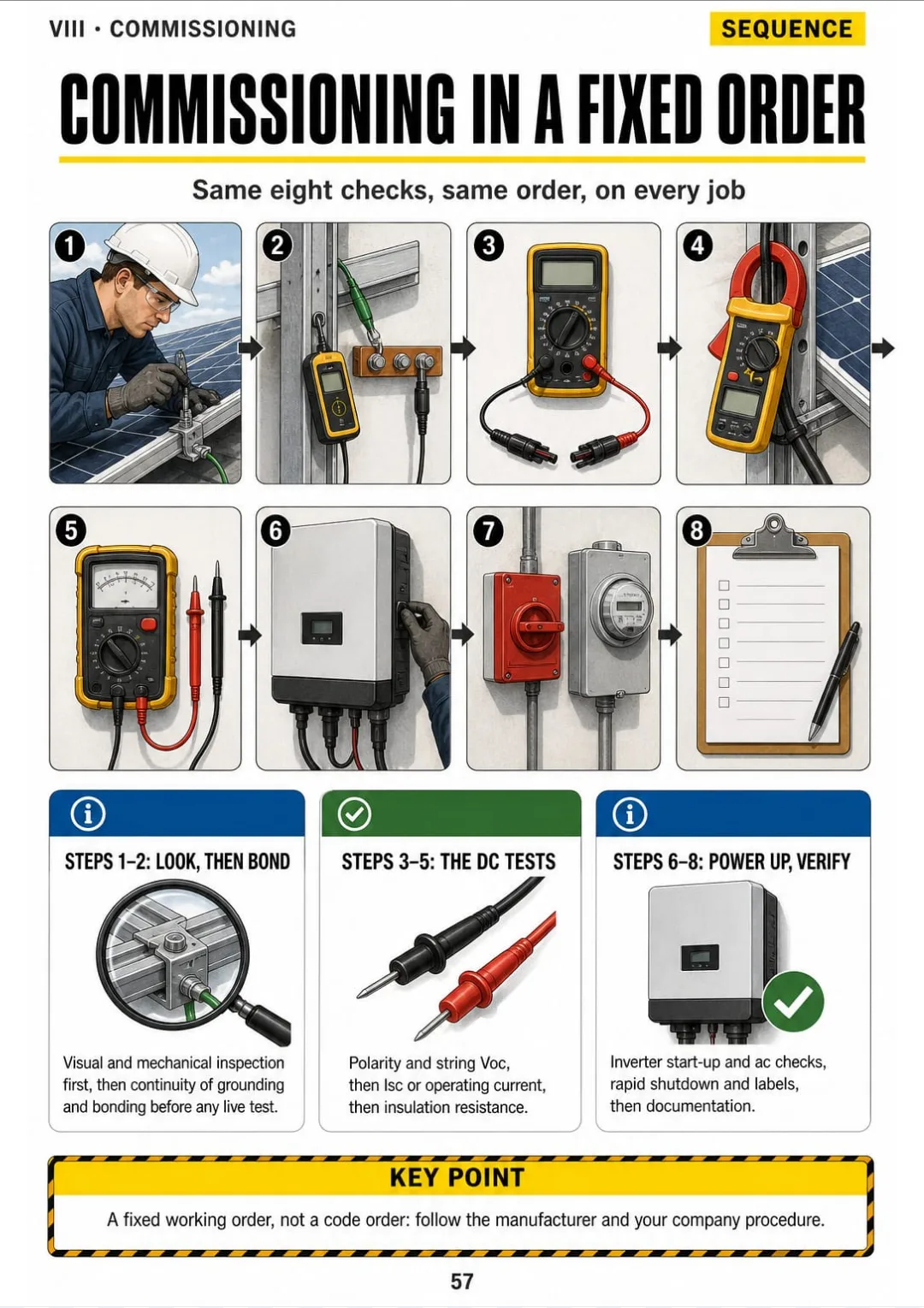
Inspection → bonding → polarity/Voc → Isc → insulation → start-up → rapid shutdown → documents.
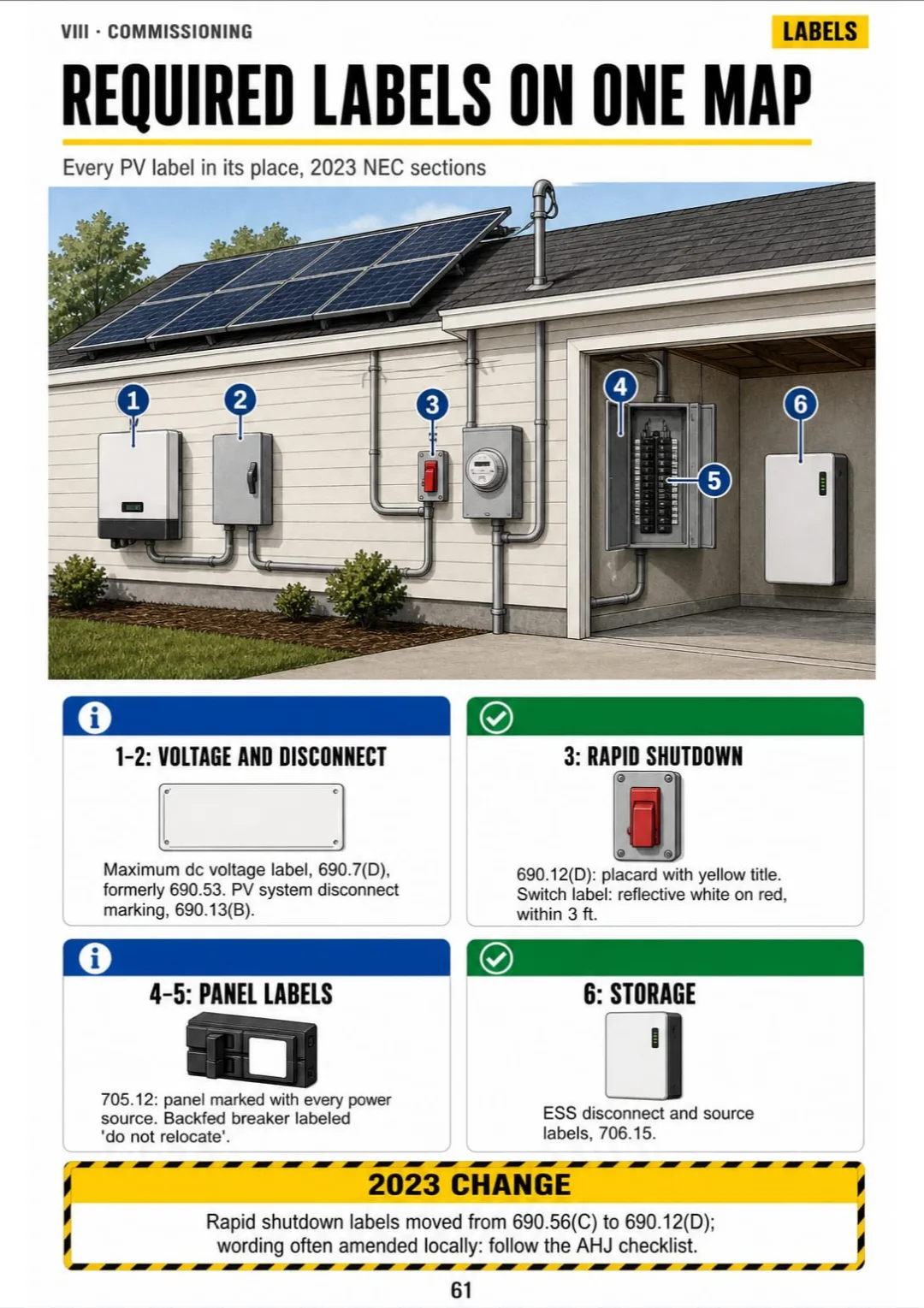
690.7(D), 690.13(B), 690.12(D), 705.10, 705.12(B), 706.15: every label on one map.
Exam day: handbook rules, article→section→table, time per question, five pages to review.

Swipe to see more →

These are real pages from the book. The table of contents is the full one: 9 parts and 64 topics.

The Problem Isn't You. It's How It Was Explained to You.

You're on a roof with the inverter and the MLPEs already in, and the inspector asks what voltage is left inside the array boundary after someone hits the initiator.

You read 690.12 last night. The code puts it all in one dense block: boundary, conductors, voltage limits, listings, exceptions, one line after another. Nothing in there shows you what to picture.

690.12(B): ≤ 30 V outside, ≤ 80 V or UL 3741 inside, within 30 seconds

In the book, rapid shutdown is one page. The array boundary is drawn as a line around the modules: 30 V or less outside it, 80 V or less (or a UL 3741 listed system) inside it, and a clock that says 30 seconds.

Same with cold Voc, the 120% rule, grounding vs. bonding, the required labels and commissioning: each one has its own page, with the NEC section printed next to the drawing.

You see it, you understand it, and you answer the inspector without flipping back through the Code Book.

COMPARE FOR YOURSELF

The Same Topic, Two Ways to Study It

THIS
  • The code book: line after line
  • Temperature corrections explained only in words
  • You walk into the exam second-guessing
Where the PV module manufacturer provides a temperature coefficient of open-circuit voltage, the maximum PV system voltage shall be determined by correcting the rated open-circuit voltage at standard test conditions to the lowest expected ambient temperature at the installation location. The corrected value is obtained as the product of the rated Voc and the sum of unity plus the product of the temperature difference from 25 °C and the coefficient expressed as a decimal, the result then being multiplied by the number of series-connected modules in the circuit.
FOR THIS
  • Cold Voc in one drawing
  • The numbers in one box
  • You see it and you get it
Design low temp = ASHRAE extreme annual mean minimum (690.7 Informational Note)
CONTENTS

Take a Look at the 9 Parts and 64 Topics

The system as one path, string sizing, current and OCPD, disconnects and rapid shutdown, grounding, interconnection, storage and safety, commissioning and exam review: 68 pages, all illustrated

IThe System as One Path · pp. 5-11
  1. From the Cell to the Utility Meter
  2. Reading a Module Datasheet
  3. Temperature Coefficients
  4. Series vs. Parallel
  5. String, Micro or Optimizer
  6. Shading and Bypass Diodes
  7. Where Each Rule Lives in the NEC
IIString Sizing · pp. 12-19
  1. String Sizing in 5 Fixed Steps
  2. Finding the Design Low Temperature
  3. Cold Voc With the Manufacturer's Coefficient
  4. Cold Voc With Table 690.7(A)
  5. Maximum Modules per String
  6. Minimum Modules for the MPPT Window
  7. Parallel Strings and Inverter Input Current
  8. DC/AC Ratio and Clipping
IIICurrent, Conductors and OCPD · pp. 20-28
  1. Maximum Circuit Current: Isc × 1.25
  2. The Second 125%: Continuous Duty
  3. 125% vs. 120%: Two Different Rules
  4. Ampacity and the 75 °C Terminal Limit
  5. Ambient and Rooftop Temperature Correction
  6. Conduit Fill Adjustment
  7. When String Fuses Are Required
  8. Sizing the Inverter Output Breaker
  9. Voltage Drop
IVDisconnects, Rapid Shutdown and Fault Protection · pp. 29-35
  1. The PV System Disconnect
  2. Equipment Disconnects
  3. Rapid Shutdown: The Array Boundary
  4. Rapid Shutdown: 80 V and 30 V in 30 Seconds
  5. The Rapid Shutdown Initiator and Its Label
  6. DC Arc-Fault Protection
  7. Ground-Fault Protection
VGrounding and Bonding · pp. 36-41
  1. Grounding vs. Bonding
  2. Sizing the Equipment Grounding Conductor
  3. Bonding Module Frames and Rails
  4. Grounding Electrode and GEC
  5. Functionally Grounded vs. Ungrounded Arrays
  6. Protecting a Small Exposed EGC
VIInterconnection · pp. 42-49
  1. Supply Side or Load Side?
  2. The 120% Rule Step by Step
  3. 120% Rule Worked: 200 A Bus, 200 A Main
  4. Opposite End and the Do-Not-Relocate Label
  5. Downsizing the Main to Make Room
  6. The 100% Sum Rule and Center-Fed Panels
  7. Supply-Side Connection
  8. Utility Interconnection and Anti-Islanding
VIIStorage, Mechanical and Safety · pp. 50-56
  1. AC-Coupled vs. DC-Coupled Storage
  2. Article 706: ESS Basics
  3. Battery Sizing: kWh, Depth of Discharge, Efficiency
  4. Roof Attachments and Flashing
  5. Fire Access Pathways
  6. Fall Protection
  7. DC Is Live in Daylight
VIIICommissioning and Labels · pp. 57-62
  1. Commissioning in a Fixed Order
  2. Polarity and Voc Check
  3. Isc Check Against Irradiance
  4. Insulation Resistance Test
  5. Required Labels on One Map
  6. Troubleshooting a Low String
IXExam Review · pp. 63-68
  1. What the PVIP Exam Covers
  2. Every Formula on One Page
  3. Round Up or Round Down?
  4. The Mix-Ups That Show Up Most
  5. Exam-Day Checklist
  6. The Whole Path, Recap

One Page, One Topic, All Clear

Think of it this way:

It's 9 p.m., two weeks before your PVIP exam. A practice question gives you a 49.5 V module, a −10 °C design low and a −0.28 %/°C coefficient. You need the cold Voc before you can count modules per string.

You open page 14 and the steps are drawn in order: −10 °C minus 25 °C is −35, times −0.0028 gives +0.098, and 49.5 V × 1.098 = 54.35 V per module, with 690.7(A) printed right beside it.

UL 1741 SB / IEEE 1547-2018: stop within 2 s on island, reconnect after 300 s by default

Same with rapid shutdown, the 120% rule, grounding vs. bonding, the required labels and commissioning: each one on its own page.

Solar PV Installer Illustrated is 9 parts and 64 topics, all drawn, and it closes with an exam review: every formula on one page, round up or round down, and an exam-day checklist.

What you see drawn, you don't have to memorize.

What's Inside Solar PV Installer Illustrated:

Ipp. 5-11

The System as One Path

The whole system from the cell to the utility meter, reading a datasheet, temperature coefficients, series vs. parallel, string, micro or optimizer, bypass diodes and where each rule lives in the NEC.

IIpp. 12-19

String Sizing

String sizing in 5 fixed steps: design low temperature, cold Voc with the coefficient or Table 690.7(A), max and min modules per string, parallel strings and DC/AC ratio.

IIIpp. 20-28

Current, Conductors and OCPD

Isc × 1.25, the second 125%, why 125% and 120% are different rules, 75 °C terminals, rooftop and conduit fill corrections, string fuses, the output breaker and voltage drop.

IVpp. 29-35

Disconnects, Rapid Shutdown and Fault Protection

The PV system disconnect, equipment disconnects, the array boundary, 80 V and 30 V in 30 seconds, the initiator and its label, arc-fault and ground-fault protection.

Vpp. 36-41

Grounding and Bonding

Grounding vs. bonding, sizing the EGC, bonding frames and rails, the electrode and GEC, functionally grounded arrays and protecting a small exposed EGC.

VIpp. 42-49

Interconnection

Supply side or load side, the 120% rule step by step and worked on a 200 A panel, opposite end, downsizing the main, the 100% sum rule, supply-side taps and anti-islanding.

VIIpp. 50-56

Storage, Mechanical and Safety

AC- vs. DC-coupled storage, Article 706 basics, battery sizing, roof attachments and flashing, fire access pathways, fall protection and why DC is live in daylight.

VIIIpp. 57-62

Commissioning and Labels

Commissioning in a fixed order: polarity and Voc, Isc against irradiance, insulation resistance, every required label on one map and troubleshooting a low string.

IXpp. 63-68

Exam Review

What the PVIP exam covers, every formula on one page, round up or round down, the most frequent mix-ups, an exam-day checklist and the whole path recapped.

At the end of the book: An exam review part with every formula on one page, round-up rules and an exam-day checklist.
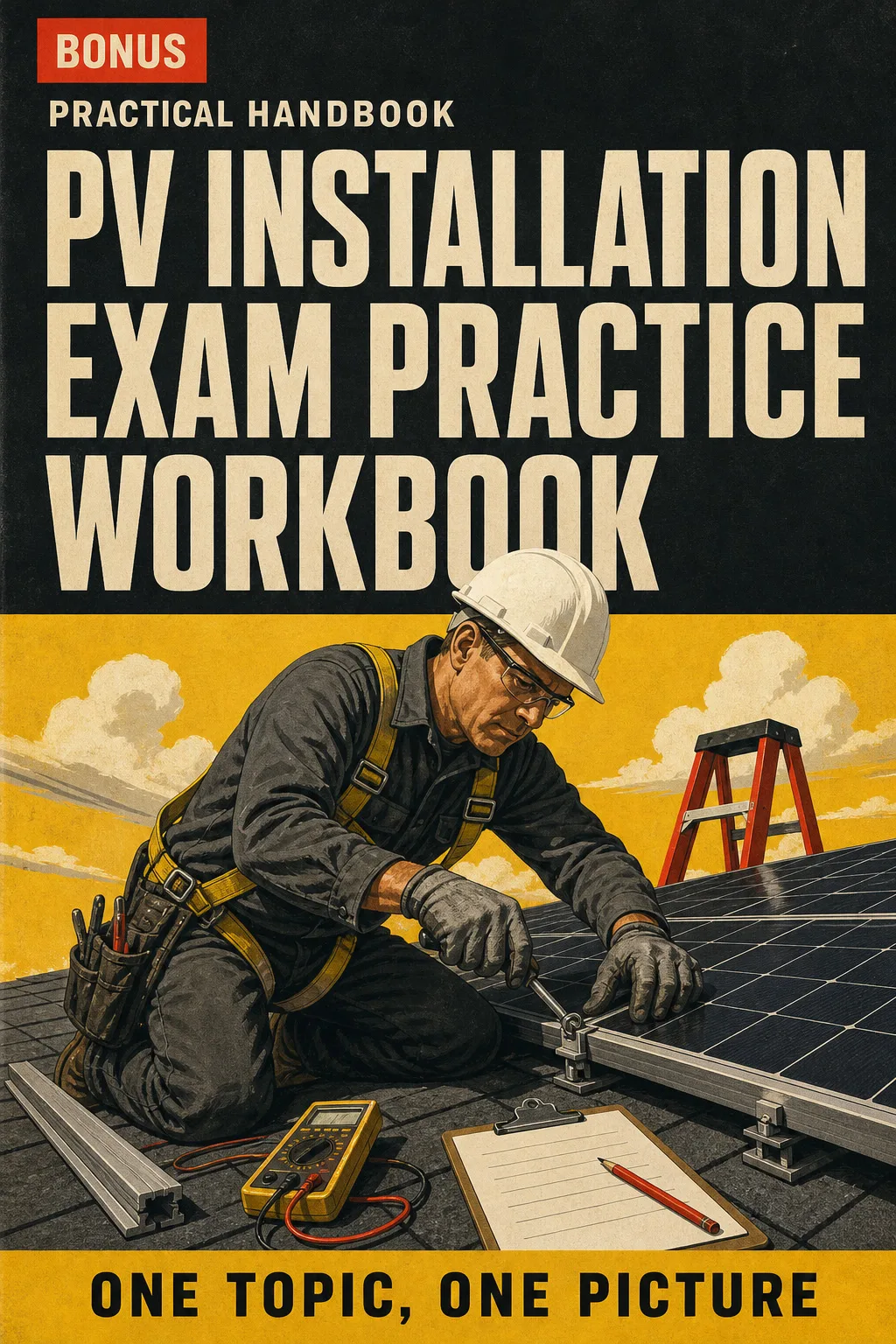
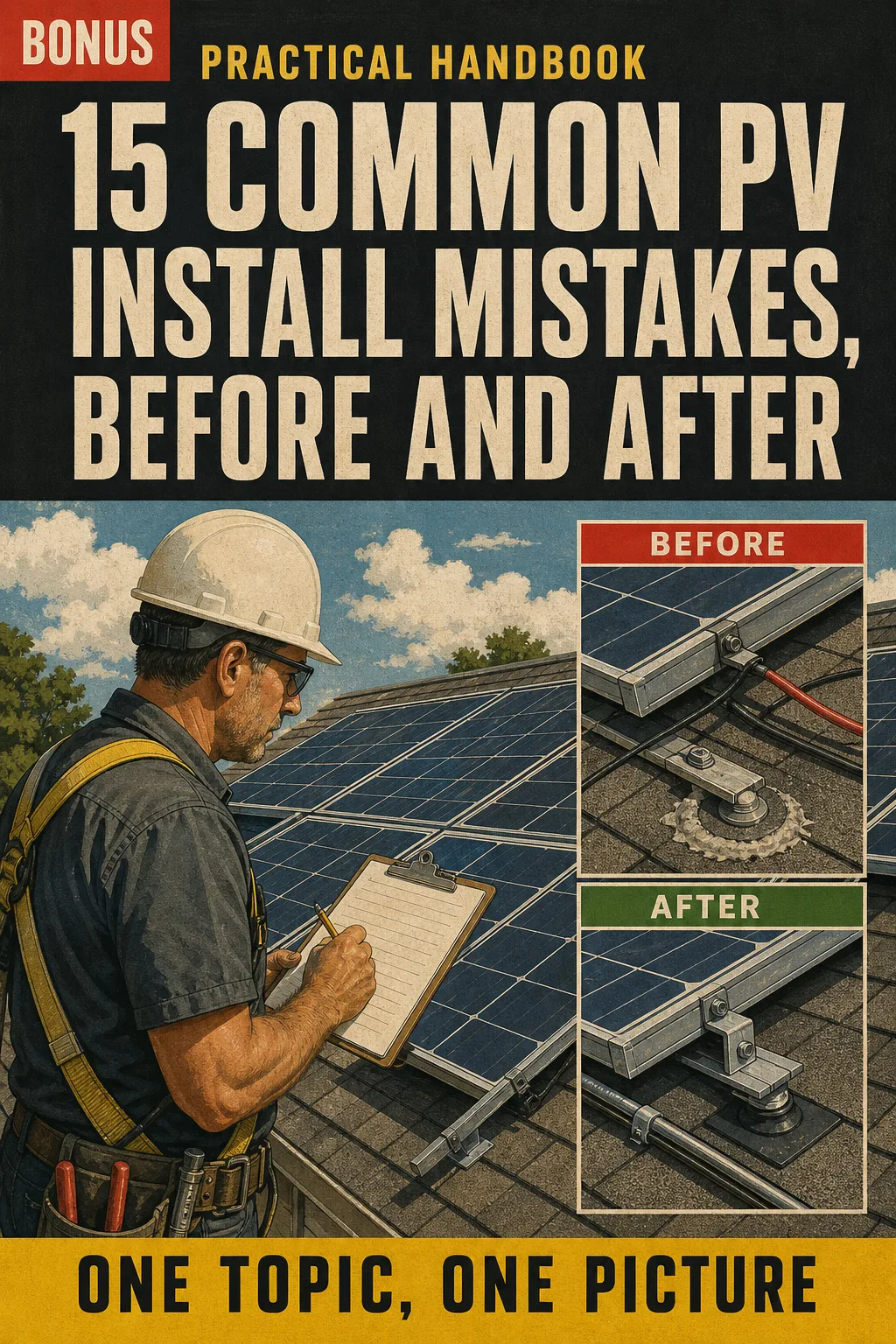
Plus: 2 Free Books

PV Installation Exam Practice Workbook

BONUS 1: «PV Installation Exam Practice Workbook»

Value on its own: US$ 17.90

Exam-style questions on string sizing, conductor sizing, the 120% rule and rapid shutdown, each answer worked step by step so you see exactly where you went wrong.

15 Common PV Install Mistakes, Before and After

BONUS 2: «15 Common PV Install Mistakes, Before and After»

Value on its own: US$ 14.90

The most frequent errors on the roof and in the calculations, each drawn wrong and then right, so you can review them in one sitting before the exam.

Solar PV Installer Illustrated with 2 Free Books

  • Solar PV Installer Illustrated: 68 illustrated pagesUS$ 63
  • BONUS 1: PV Installation Exam Practice WorkbookUS$ 17.90
  • BONUS 2: 15 Common PV Install Mistakes, Before and AfterUS$ 14.90
  • High-resolution PDF to printIncluded
Total value US$ 95.80
YOUR PRICE:
US$ 27
You save US$ 68.80
YES, I WANT SOLAR PV INSTALLER ILLUSTRATED FOR US$ 27

📄 This is a digital PDF book sent to your email: nothing is printed or shipped.

Secure purchaseEncrypted payment30-day guarantee

PDF by email: We email you Solar PV Installer Illustrated as a PDF, together with the two free books. It's a single payment: no installments, no extra charges.

Who This Book Is For

You're moving into solar as an electrician

You're moving into solar as an electrician

You already know wiring. The book shows you what changes on the DC side: cold Voc, rapid shutdown and the 120% rule, each drawn with its NEC section.

Your PVIP exam date is set

Your PVIP exam date is set

You review one topic per page at night, with every calculation solved in the same fixed steps, and finish with every formula on one page.

You already lead a crew

You already lead a crew

You know how to do it on the roof. The book draws the why, so you can explain it to the inspector, to your crew and on the exam.

Everything You Get Today

US$ 95.80US$ 27
YES, I WANT SOLAR PV INSTALLER ILLUSTRATED FOR US$ 27

📄 This is a digital PDF book sent to your email: nothing is printed or shipped.

30DAYS
GUARANTEE

30-Day Guarantee

Try Solar PV Installer Illustrated for 30 days, bonus books included.

We refund everything if the file won't open, if the book isn't what you see here, if you were charged twice or if the email doesn't arrive. Just email us.

You pay once. No subscriptions.

Frequently Asked Questions

Is it for me if I already install PV and want the NABCEP PVIP?

Yes. It doesn't explain what a panel is. It goes straight to what the exam asks: string sizing, conductors and OCPD, rapid shutdown, grounding, interconnection, storage and commissioning, each drawn on its own page. The Code Book gives you the rule in text; here it's drawn, with the NEC section beside it, and every calculation is solved in the same fixed steps.

Where does the content come from?

From the NEC 2023 (NFPA 70), Articles 690, 705 and 706 plus 110, 250 and 310, cross-checked against the NABCEP PVIP Job Task Analysis. Before your exam, check which NEC edition NABCEP lists in its current Candidate Handbook. On the job, your state may have adopted another edition, and your AHJ can add local amendments.

Is it official material?

No. It's an independent illustrated study guide, not affiliated with NABCEP or NFPA.

Does it replace a training course?

No. It's a study and review book. It doesn't count toward NABCEP training hours, it doesn't give you a certificate, and it doesn't replace your field experience or the Code Book itself.

Are the practice questions the ones on the exam?

No. They are written for this book, in exam style, with each answer worked step by step. They are not official NABCEP questions.

When and how do I get it?

The book and the 2 bonus books come as PDFs by email, to the address you enter at checkout.

Do I have to pay every month?

No. It's a one-time payment. No subscription.

Can I have it on paper?

Yes. The PDF is printable, so you can print it at home or at a print shop and keep it in the truck.

How does the refund work?

You have 30 days. We refund everything if the file won't open, if the book isn't what you see on this page, if you were charged twice or if the email doesn't arrive: just email us.

Before You Close This Page

No more rereading the code with nothing sticking.

Rapid shutdown: you see it drawn, and that's it.

You walk into the PVIP exam knowing where every rule lives.

Drawings make studying faster.

The book is right below.

One-time payment: US$ 27 · Guarantee: 30 days · PDF by email

YES, I WANT SOLAR PV INSTALLER ILLUSTRATED FOR US$ 27

📄 This is a digital PDF book sent to your email: nothing is printed or shipped.